
STORY #15: Conditions to Build in the Country Club District
When the Metcalfe Company sold lots in the Country Club District, buyers agreed to a detailed set of building conditions—rules designed to shape the look, feel, and “status” of the new neighborhood. According to the property abstracts, these provisions remained in effect until January 1968.
They required that:
◈ Only a brick-veneer dwelling house could be built
◈ Homes had to cost at least $5,000 (a substantial sum in the 1920s)
◈ Each house be built on a solid foundation, with brick above grade
◈ Homes be set back at least 40 feet from the street and four feet from side lot lines
◈ Garages or outbuildings, if not attached, be placed at the rear of the lot
These rules ensured wide lawns, generous spacing between homes, and a consistent, high-quality appearance—hallmarks that still define the neighborhood today.
The abstracts also spelled out the costs of modern infrastructure. A Decatur Street lot, for example, carried special assessments paid in installments:
Paving & curbing: 10 payments of $29.90
Water main: 10 payments of $10.11
Gas main: 10 payments of $5.56
One provision in these documents reflects a painful chapter of American history: a racially restrictive covenant stating that the property could only be occupied by people “of the Caucasian race.” Such language was common in early 20th-century developments across the country. These covenants were effectively outlawed in Omaha and throughout the U.S. by the federal Fair Housing Act of 1968. While the U.S. Supreme Court ruled these covenants unenforceable in 1948, it was not until 1968 that they were fully banned. Their presence reminds us that beauty and exclusion were often built side by side.
Understanding these conditions helps us see how the Country Club District was shaped—by design, by economics and by the social values of its era.
Source: Country Club District Abstract of Title
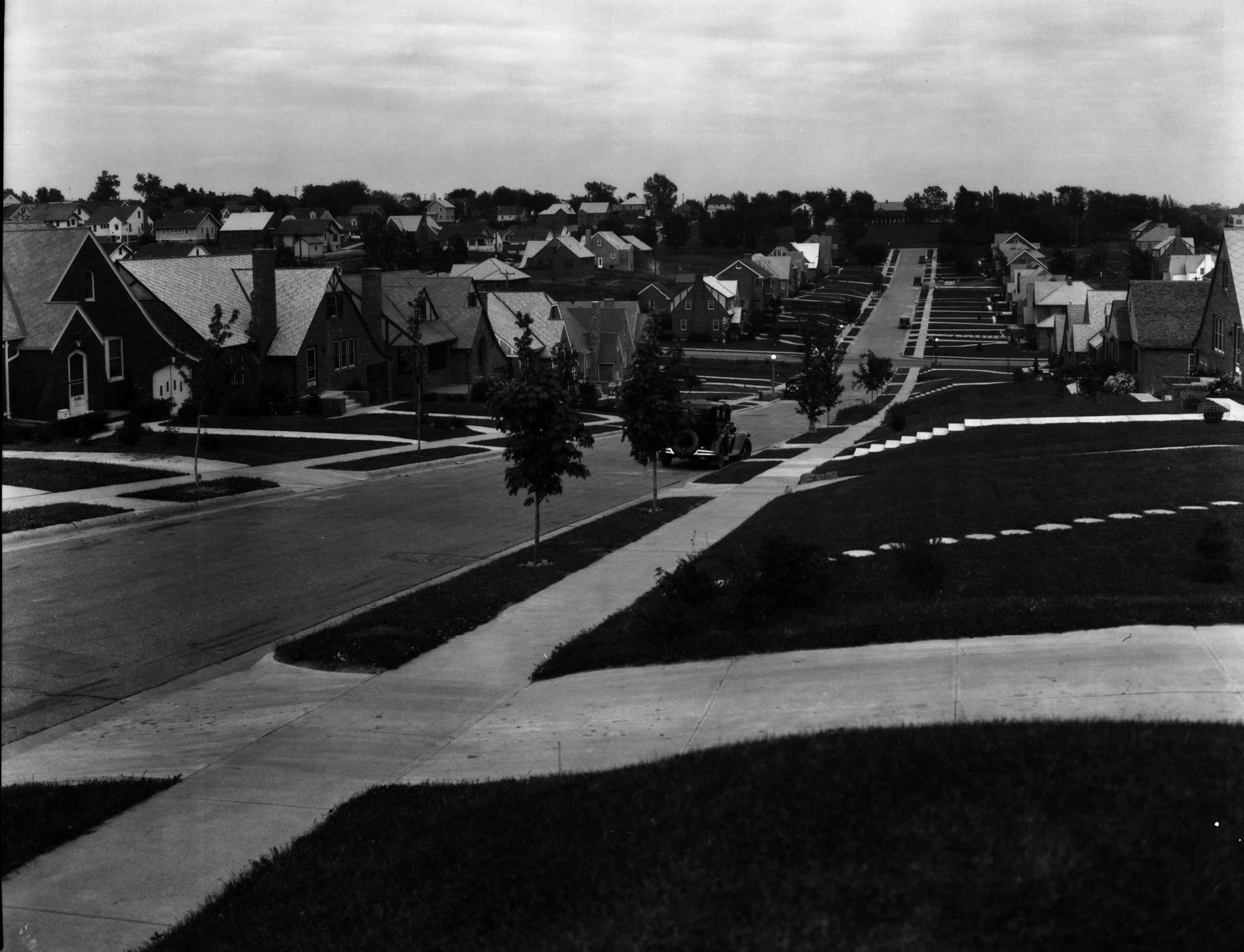
Caption: 1932 view of 52nd and Parker looking East courtesy The Durham Museum. BF61-211
